

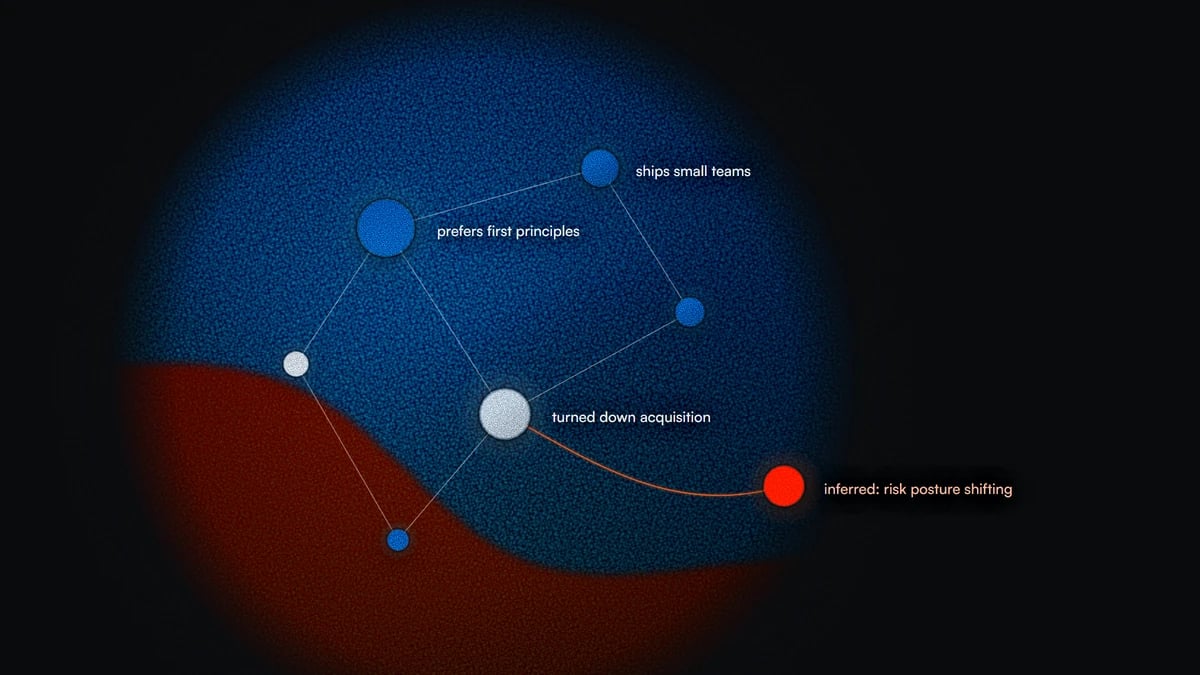
What Exo stores
Five kinds of thing, in one substrate.
The four discovered views are one operation, not four routes.
GET /v1/recall/{recall_type} serves identity, graph, insights and temporal from the same endpoint, and every response carries a type field naming which of the four shapes you got. Contradictions and proposals live under the insights tag in the reference rather than a tag of their own.
That type field is the discriminator to branch on, and each view fills in independently as the background cycle warms it:
200 application/json
How content becomes cognition
Ingestion is the fast path: content arrives, gets chunked, embedded and linked, and is retrievable as soon as its job succeeds. The cognition cycle is the slow path: it runs in the background and fills in the discovered layers. That split is why a freshly imported subject can retrieve immediately but gets empty collections from the recall views for a while. It is not an error, and Memory lifecycle says what to watch instead of guessing.The seven objects
These are the objects Exo returns that a passage index has no way to express. Each one gets a page, a real payload, and a plain statement of what is not true yet.Cognition
Why the answer, not only what: the nodes the model settled on, how strongly it settled, and whether it thought fast or slow.
Contradiction
Two positions the same person held, kept side by side with a salience score instead of quietly reconciled.
Belief and supersession
What someone used to think, what replaced it, when, and where the authority went.
ManifoldState
The axes this person’s thinking actually varies along, discovered from their content rather than chosen from a personality list.
Phase
The eras of their history, clustered from the dates inside the content.
ConditioningPack
A ready-to-inject prompt that makes your own model reason and sound like them.
AgentFailurePattern
The recurring ways a team’s coding agents go wrong, clustered from evidence and reported without naming anyone.
The model underneath
The knowledge graph
Nodes, edges, domains and authority: the substrate everything else reads.
How a memory is made
Ingest, edit, supersede, forget, undelete, purge. The full life of one node.
Brain path and hybrid path
Which engine served your call, and what degraded actually means.
Insights and proposals
Why the background cycle proposes connections instead of asserting them.
Subjects and isolation
Orgs, users and subjects: one memory per end user of your product.
ExoBrain
The per-org model, when it serves, when it goes stale, and what training costs you.